Roller Barrier vs W-Beam Guardrail
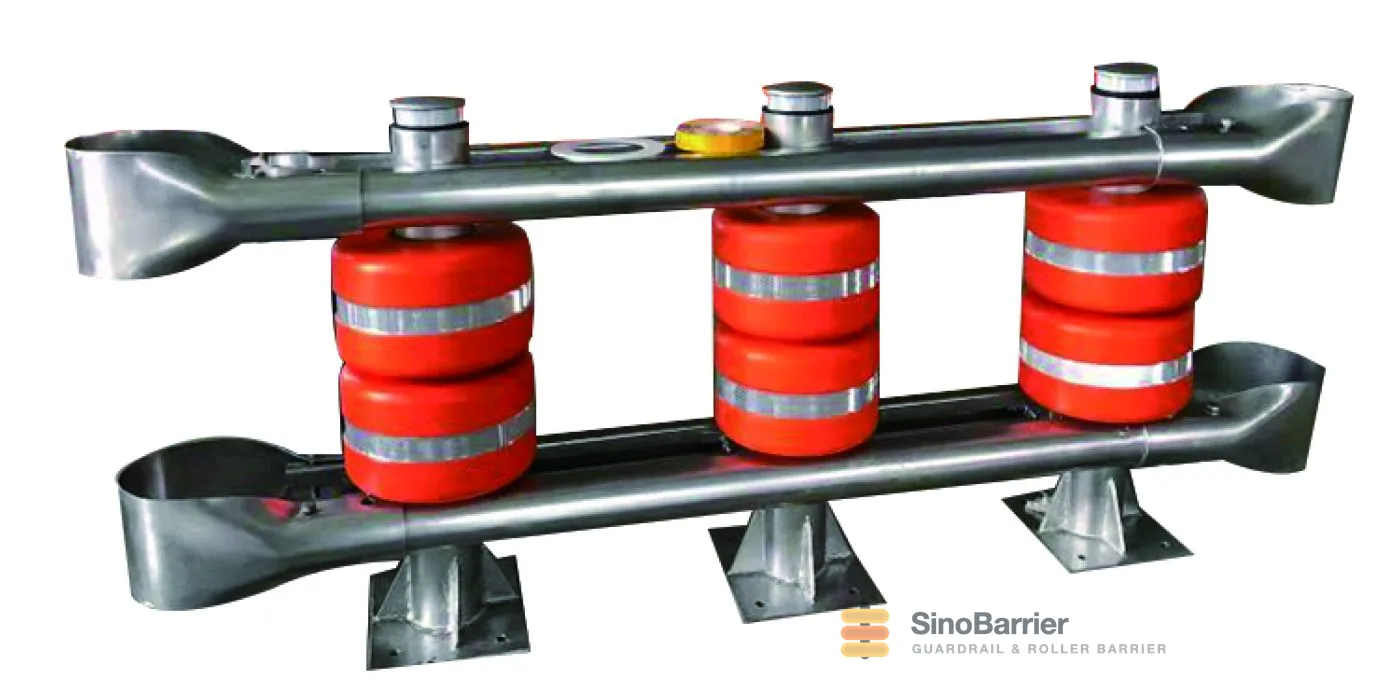
Short answer: specify a W-beam guardrail for long, straight or gently curved runs where standard deflection is acceptable and budget per metre matters. Specify a roller barrier where deflection cannot be tolerated — sharp curves, tunnel walls, bridge approaches and known run-off-road hotspots — because rotating rollers redirect a vehicle along the barrier line instead of letting the beam deform into it. Both are legitimate systems; they simply win in different places.
This guide compares the two systems the way a specifier needs to see them: by crash mechanism, deflection behaviour, containment, maintenance and cost over the life of the road — not by marketing claims. SinoBarrier manufactures both systems in the same factory, so the comparison below is honest about where each one belongs.
The difference at a glance
| Parameter | W-beam guardrail | Roller barrier |
|---|---|---|
| Crash mechanism | Beam corrugation deforms; load transfers to posts and soil | Rollers rotate; kinetic energy converts to rotation, then to redirection |
| Deflection on impact | Typically 0.5–1.5 m depending on post spacing and soil | Near-zero lateral deflection — the barrier keeps its line |
| Behaviour at shallow angles | Vehicle may ride along or rebound off the beam face | Rotating surface steers the vehicle back toward its lane |
| Containment level | Standard highway containment per AASHTO M180 hardware | Verified to MASH TL3/TL4 test levels |
| Best applications | Long straight runs, medians, general expressway mileage | Curves, tunnels, bridges, medians on high-speed roads, blackspots |
| Cost per metre | Lower — the global default for a reason | Higher per metre, justified where crash risk or deflection space is the constraint |
| Maintenance profile | Replace deformed panels and posts after impact | Inspect rollers; replace only the units an impact damaged |
When W-beam is the right answer
W-beam is the most specified highway barrier in the world because it solves the majority of run-off-road risk at the lowest cost per metre. It is the correct choice when the site gives you room to deflect, the alignment is straight or gently curved, and the hazard behind the barrier is forgiving. Typical W-beam applications:
- Long expressway and rural highway runs where millions of metres must be covered within budget
- Medians with adequate deflection distance to the opposing carriageway
- Ramps and straight sections with standard shoulder widths
- Projects specified against AASHTO M180 hardware requirements
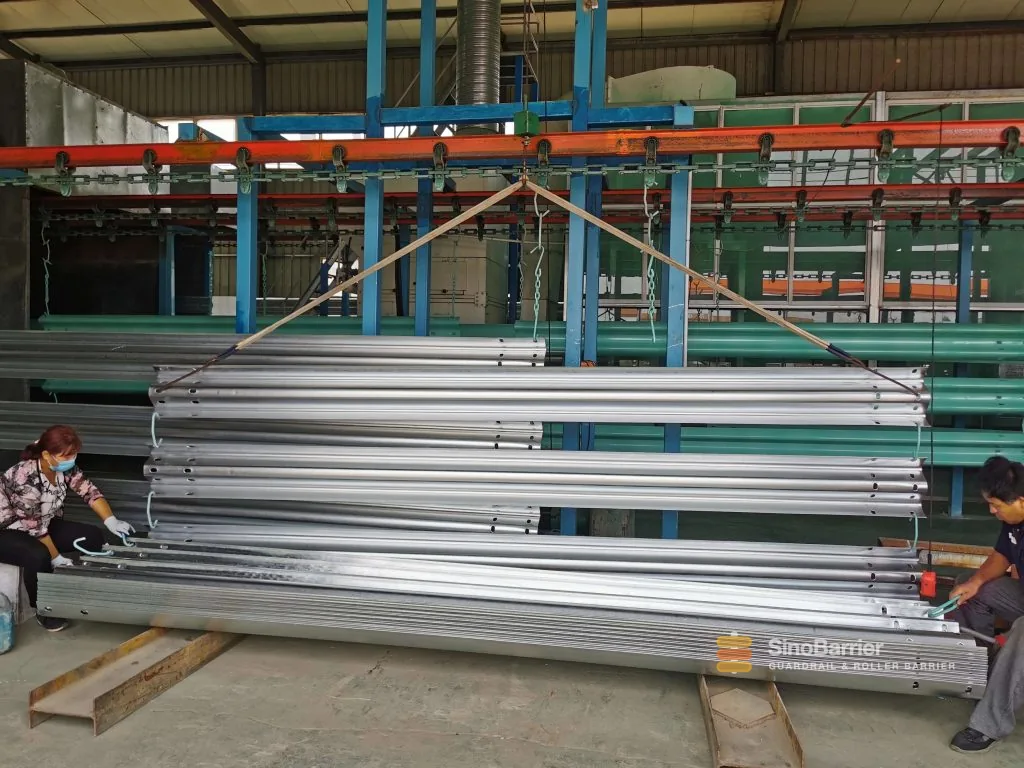
The full section data — dimensions, steel grade, coating weight — is collected on our W-beam specifications page.
When a roller barrier is the right answer
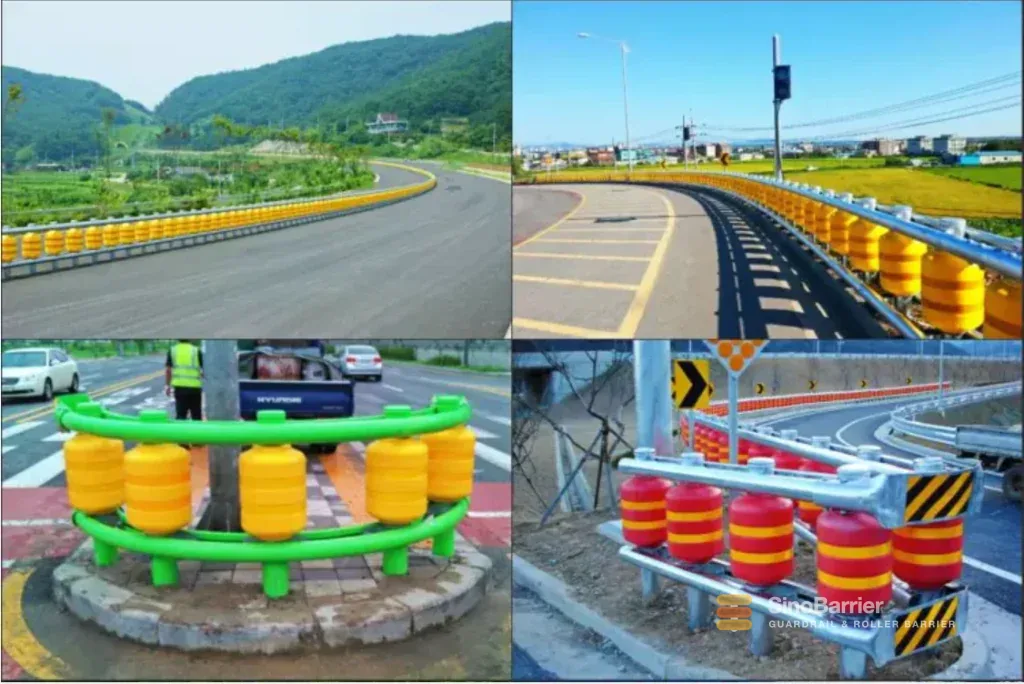
A roller barrier earns its premium wherever a conventional beam would either deflect too far or reflect a vehicle back into traffic. The rotating rollers convert a share of the crash energy into rotation and steer the vehicle along the barrier line. Specify it for:
- Sharp curves and mountain roads — vehicles arrive at an angle; redirection beats deflection
- Tunnels and portal approaches — no room for a beam to deform toward a wall or opposing traffic
- Bridge approaches and narrow medians — near-zero deflection protects the structure and the opposing lane
- Known accident blackspots — where the crash history justifies a higher-specification system
The two standard configurations — diameter and spacing options — are on the rolling barrier system page, and the crash-test evidence behind them is on the MASH TL4 and EN 1317 testing page.
Cost over the life of the road, not the purchase order
Comparing a roller barrier to W-beam on purchase price alone is misleading. After a W-beam impact, crews typically replace deformed panels, posts and blocks for the damaged length. After a roller barrier impact, inspection identifies the specific rollers and posts that need replacement — often a fraction of the run. On high-frequency-impact sections, lower replacement scope plus fewer lane closures can offset the higher initial cost within a few maintenance cycles. Our roller barrier price guide explains how to compare quotations on a like-for-like basis.
What about thrie-beam as a middle option?
If the site needs more stiffness and containment height than W-beam but not the energy-absorbing behaviour of a roller system, thrie-beam is the middle step — a taller three-wave section specified for bridges and transitions. A common export configuration is thrie-beam on the structure and W-beam on the approaches, with the roller barrier reserved for the curve or tunnel where deflection is unacceptable.
How we help you decide
Send the alignment, the road class and the hazard you are protecting. Our engineering team — manufacturer, not trader — returns a system recommendation with the reasoning: where the run takes W-beam, where it takes rollers, and what the transition details look like. With 555+ projects exported to 28+ countries since 2010, the selection logic is well tested.
Request a system recommendation
FAQ
Is a roller barrier better than W-beam guardrail?
Neither is universally better. W-beam wins on cost for long straight runs; a roller barrier wins where deflection cannot be tolerated and crash risk is concentrated — curves, tunnels, bridges and blackspots. Choose by site behaviour, not by product preference.
What is the deflection difference between the two systems?
A W-beam guardrail deflects roughly 0.5–1.5 metres depending on post spacing, section and soil. A roller barrier keeps near-zero lateral deflection because the rollers redirect the vehicle instead of the beam deforming. Where the barrier sits close to a wall, a structure or opposing traffic, that difference decides the choice.
Which system costs more per metre?
The roller barrier has a higher cost per metre. The honest comparison adds maintenance: W-beam panels and posts are replaced after most impacts, while roller barriers often need only the impacted roller units replaced. On high-impact sections the lifecycle gap narrows considerably.
Can the two systems be combined on one road?
Yes, and it is common. W-beam covers the general alignment, thrie-beam handles structures and transitions, and roller barrier is installed on the curves, tunnel sections and blackspots where its redirection behaviour justifies the cost. Transition details are part of our supply scope.
¿Necesita especificar esto en un proyecto en curso?
Solicitar cotización