Galvanized Guardrail Standards
Short answer: for export projects, galvanized guardrail is specified to AASHTO M180 in North America and most export markets — minimum 550 g/m² hot-dip galvanized coating on corrugated beam — and to the European EN 10346 / EN ISO 1461 framework in EU-facing projects, where coating weight scales with steel thickness. The number that decides field life is the coating weight, not the visual finish, and the document that proves it is a coating-weight test report issued per batch.
This page compares the two standard frameworks the way a tender engineer needs them: what each requires, how the coating works in the field, and how to write the requirement into a specification so it is enforceable. SinoBarrier rolls and galvanizes to both frameworks from the same Shandong plant.
AASHTO M180: the export benchmark
AASHTO M180 is the North American standard for corrugated sheet steel beam guardrail — and the de facto reference for export projects worldwide. The requirements that matter in practice:
- Coating weight: 550 g/m² minimum for the standard highway class, verified by coating-weight test
- Base metal and mechanical properties: grade, thickness and formability requirements for the corrugated section
- Dimensions: section width, depth and corrugation geometry for the W-beam and thrie-beam families
- Verification: mill certificate plus coating-weight report per production batch
Our conformity documentation is collected on the AASHTO M180 certification page, and the section values that sit inside the standard are on the W-beam specifications page.
EN 10346 / EN ISO 1461: the European framework
European projects reference continuous hot-dip galvanizing through EN 10346 (for continuously coated flat products) and EN ISO 1461 (for hot-dip galvanized coatings on fabricated steel). Where M180 names one coating weight for the highway class, the EN framework scales the coating with steel thickness — thicker sections call for heavier coatings. The practical consequence for a specifier: quote the standard and the coating class together, because “galvanized to EN” alone does not pin a number.
| Standard | Coating requirement | Region | Specified as |
|---|---|---|---|
| AASHTO M180 | 550 g/m² minimum (highway class) | North America and most export markets | “AASHTO M180, min. 550 g/m²” |
| EN 10346 | Coating weight by steel thickness class (Z-mass designations) | Europe | Standard + Z-mass class |
| EN ISO 1461 | Mean coating thickness by section thickness category | Europe (fabricated parts) | Standard + category |
What the coating actually does in the field
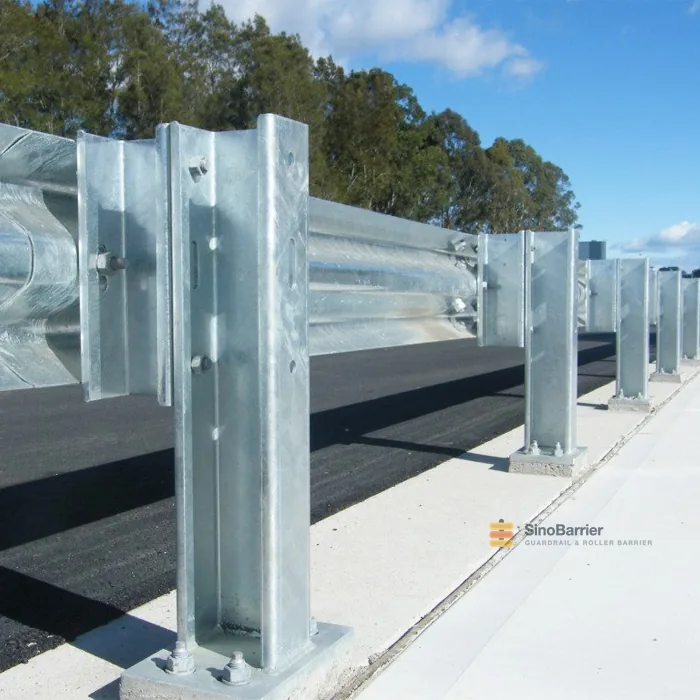
The zinc layer protects in two ways. First, it is sacrificial: zinc corrodes preferentially to steel, so scratches and edge cuts in the coating still leave the steel beneath protected. Second, it slows atmospheric corrosion on the exposed surface. Coating weight therefore maps directly to service life: a 550 g/m² class barrier in a temperate inland climate measures its life in decades, while the same coating in a coastal or high-humidity environment consumes faster — which is why coastal specifications call a heavier class. The coating weight, not the shine, is the number that matters; a bright finish with a light coating fails the specification and the field test.
Base metal: the other half of the specification
Coating protects the steel; the steel grade decides the section’s mechanical behaviour. SinoBarrier rolls from Q235B or S355JR depending on the project specification — S355JR for projects needing the higher yield strength. Both grades are rolled to the corrugation geometry the standard requires, and every batch ships with a mill certificate. A coating report without a mill certificate is half a verification; insist on both.
How to write it into a specification
Reference the standard by number plus the coating class, and name the verification documents. Enforceable wording looks like this:
“Corrugated steel W-beam guardrail, hot-dip galvanized conforming to AASHTO M180, minimum coating weight 550 g/m², base metal Q235B or S355JR with mill certificate, coating-weight test report issued per production batch.”
That sentence can be tendered against, checked at delivery and enforced at dispute — which is the entire purpose of naming the standard correctly.
Verification documents to demand with the shipment
- Mill certificate for the base metal, per batch
- Coating-weight test report for the galvanizing, per batch
- Certificate of conformity to the named standard
All three are issued as standard with SinoBarrier shipments and are available up front with the quotation for tender submissions.
See the AASHTO M180 certification page
FAQ
What does 550 g/m² galvanizing mean on guardrail?
It is the minimum total zinc coating weight per square metre of steel surface, the highway class under AASHTO M180. The value is verified per production batch by coating-weight test report — it is the number that maps to field service life, which is why specifications name it explicitly rather than relying on the word “galvanized”.
Which is better for export projects, AASHTO M180 or EN 10346?
Neither is better — they serve different markets. M180 is the benchmark for North America and most export tenders; the EN framework governs EU-facing projects and scales coating with steel thickness. Specify the standard your project’s contract references, and name the coating class together with it.
How long does galvanized guardrail last in the field?
In temperate inland conditions, a 550 g/m² coating measures its service life in decades. Coastal and high-humidity environments consume the zinc faster, which is why those sites specify a heavier coating class. The honest answer is always a function of environment plus coating weight — which is why the coating report, not the appearance, is the document that matters.
Do I need both a mill certificate and a coating test report?
Yes — they verify different halves of the product. The mill certificate proves the base metal grade and mechanical properties; the coating-weight report proves the galvanizing. A shipment with only one of the two is not fully verifiable, and both should be available up front with the quotation for tender use.
Memerlukan spesifikasi ini untuk projek yang sedang berjalan?
Minta sebut harga