Guardrail End Terminal Types
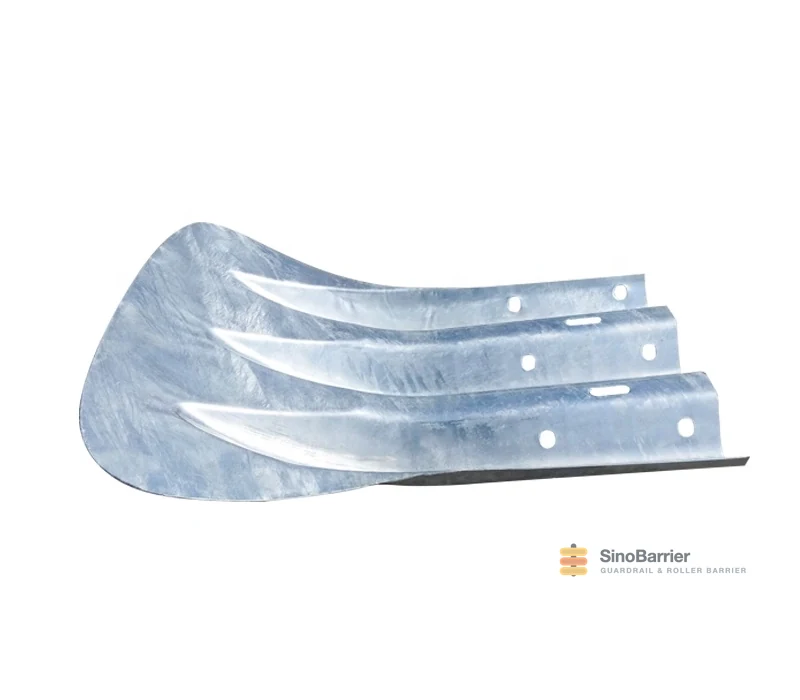
Short answer: a guardrail end terminal is the engineered treatment at the start and end of a run — the point a vehicle is statistically most likely to hit first. The terminal type decides whether that first impact is absorbed and redirected, or turns into a spearing hazard where the rail penetrates the vehicle cabin. The main types are flared, buffer/energy-absorbing, fishtail, bullnose and bridge terminals, and the choice is driven by approach speed, shoulder width and the beam profile of the run.
An untreated rail end is a spear. That single fact is why terminal design is its own engineering discipline, and why most specifications name the terminal type per run end rather than leaving it to the installer. This guide covers the types SinoBarrier manufactures and exports, and when each applies.
Why the end terminal matters more than it looks
Along the middle of a run, the rail presents a corrugated face designed to deflect and contain. At the end of the run, that same rail presents a raw steel edge pointed at oncoming traffic. Terminal types solve this in three ways: angling the rail away (flare), absorbing the impact energy (buffer and energy-absorbing terminals), or folding the rail on itself (fishtail and turned-down ends). Choosing wrong does not show up on the day of installation — it shows up in the crash statistics.
Terminal types compared
| Type | Function at first impact | Typical application |
|---|---|---|
| Flared end terminal | Angles the rail away from the traffic lane, reducing head-on exposure | Approach ends on wide shoulders and ramps |
| Buffer end terminal | Absorbs head-on impact energy in a controlled crush | Run starts on high-speed roads |
| ET-Plus / ET-2000 family | Energy-absorbing terminal systems for tangent approaches | US-specification highway projects |
| SKT / X-Lite family | Tangent and low-speed energy-absorbing terminals | Urban and lower-speed approaches |
| Fishtail end | Turns the rail ends away; simple and robust | Departure ends, low-exposure locations |
| Bullnose end | Rounded full-width terminal for median impacts | Medians and gore areas |
| Bridge end terminal | Connects the run to a bridge parapet or railing | Bridge approaches and structure transitions |
Flared versus tangent approaches
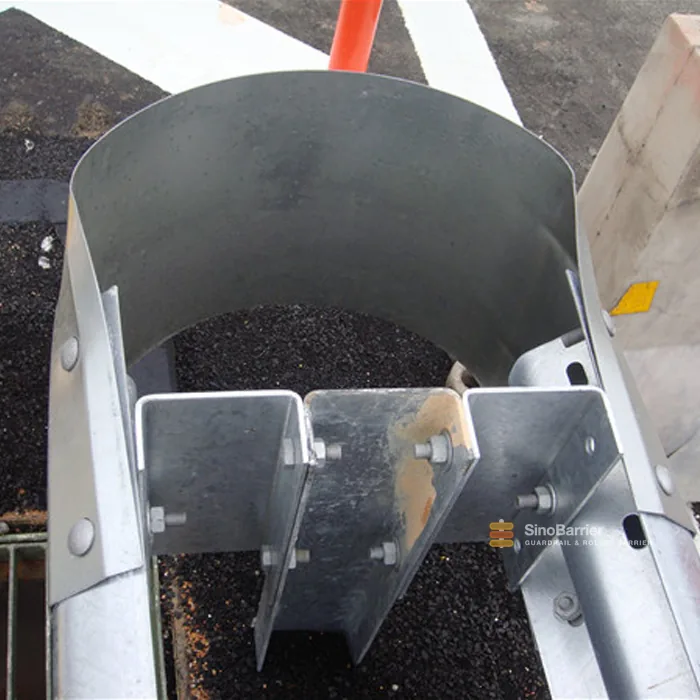
The first decision is geometric: does the run have room to flare? A flared terminal angles the rail away from traffic, which lowers the probability of a head-on hit — but it needs shoulder width, and the flare angle must match the approach speed. Where the shoulder is tight, a tangent (in-line) energy-absorbing terminal does the job by crushing instead: the impact head slides along the rail and absorbs the energy without the rail needing to angle away. Urban reconstructions with narrow shoulders almost always end up tangent; new rural alignments usually flare.
Energy-absorbing terminals: when the approach speed is the problem
Buffer and sliding-head terminals (the ET-Plus/ET-2000 and SKT/X-Lite families) exist because at high speed a rigid end is unacceptable regardless of flare. They absorb the head-on impact through a controlled deformation sequence, then the gate section folds and the vehicle is guided past. These are the terminals specified on high-speed highways and where accident history has already demonstrated what an untreated end does. Test-level documentation for the systems we supply is available with the order — the framework is explained on our MASH and EN 1317 testing page.
How to choose — and what we need from you
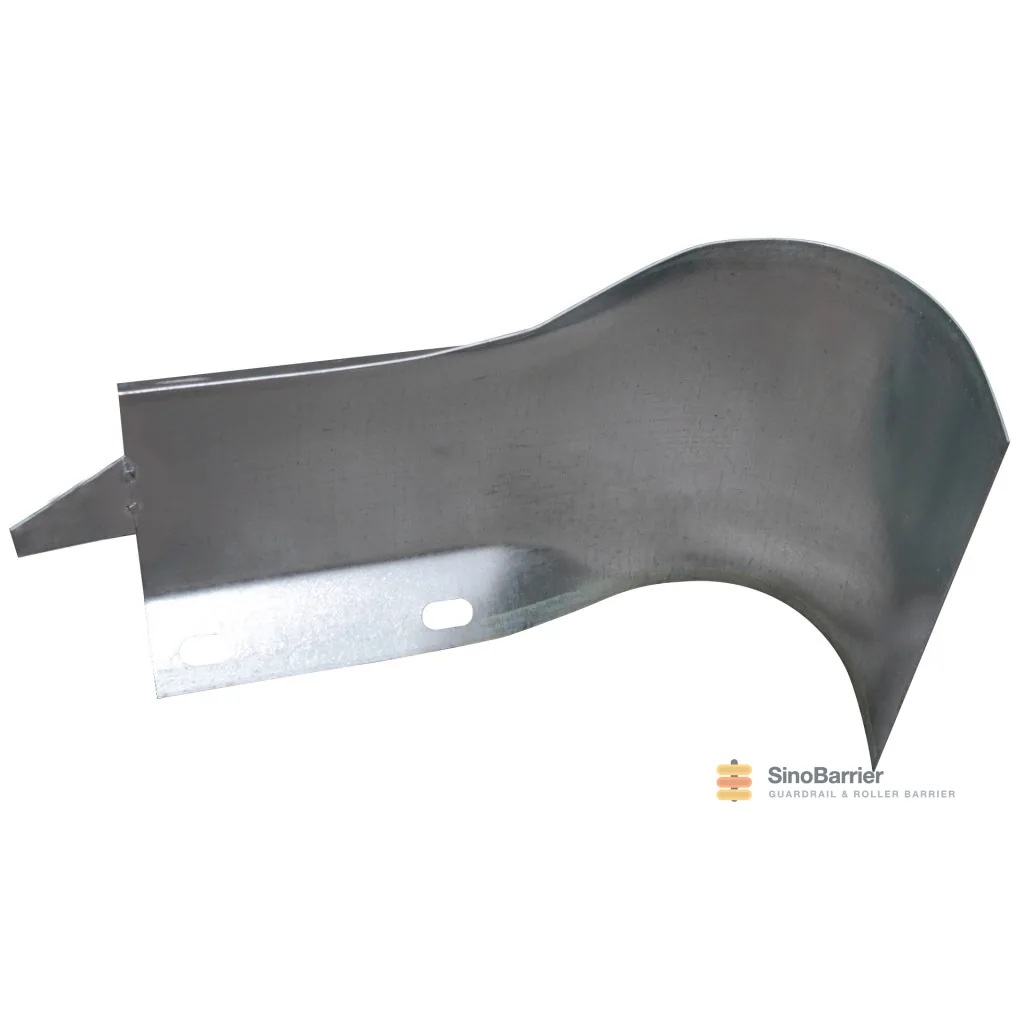
The selection depends on four inputs: beam profile (W-beam and thrie-beam take different terminal families), approach speed, shoulder width, and whether the run end faces approaching or departing traffic. Send the run layout with those four inputs and we return the terminal type and the transition detail for each end, with the panel lengths cut to match. The product families are collected on the guardrail end terminal page.
Request terminal selection support
FAQ
What does a guardrail end terminal do?
It treats the exposed end of a rail run so that a first impact is absorbed, redirected or turned away instead of the rail spearing into the vehicle. The terminal is matched to approach speed, shoulder width and beam profile — it is specified per run end, not chosen by the installer on site.
Which end terminal is used on high-speed roads?
Energy-absorbing terminals — the buffer and sliding-head families such as ET-Plus, ET-2000, SKT and X-Lite — are specified where approach speeds are high, because they absorb the head-on impact in a controlled sequence instead of relying on a flare angle alone.
What is a fishtail end on guardrail?
A fishtail end turns the two rail ends away from each other and from traffic, like a fish tail. It is a simple, robust treatment for departure ends and low-exposure locations where a full energy-absorbing terminal is not warranted by the crash history.
Do both ends of a guardrail run need a terminal?
Yes in principle — every exposed end is a spearing hazard. In practice the approach end (facing traffic) gets the higher-specification terminal, and the departure end may take a simpler treatment such as a fishtail, depending on speed, exposure and the site geometry. The layout drawing names the treatment per end.
Perlu menentukan spesifikasi ini untuk proyek yang sedang berjalan?
Minta penawaran harga