How Does a Roller Barrier Work?
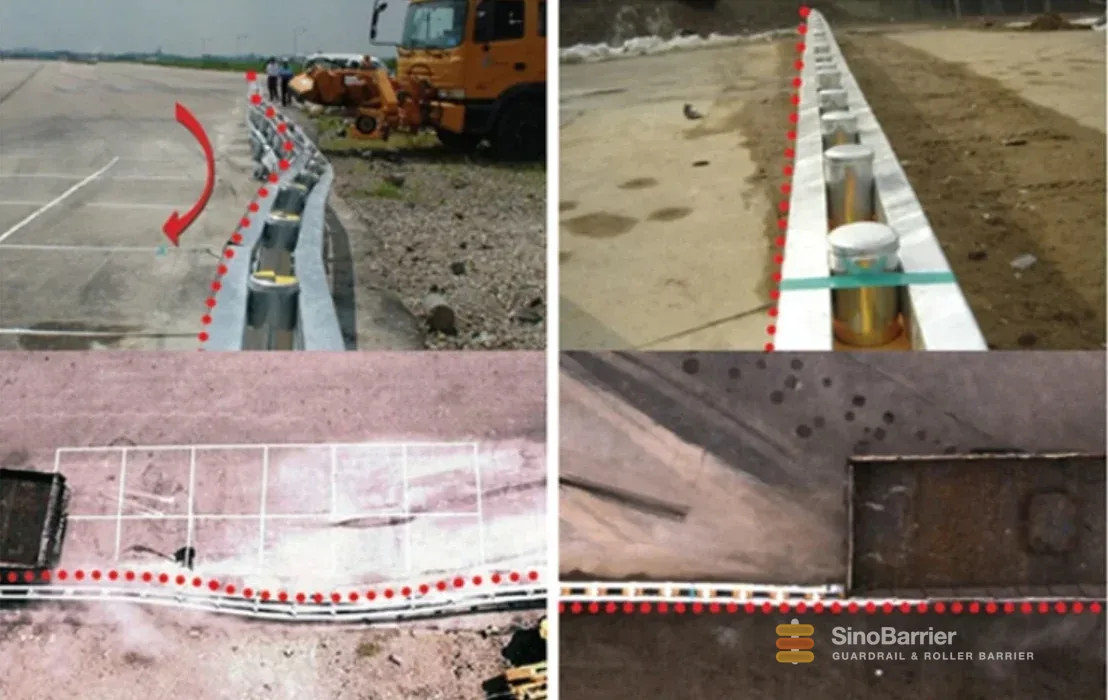
Short answer: a roller barrier works by converting crash energy into rotation. When a vehicle strikes the barrier, the rows of rotating rollers spin on their axles, absorbing a share of the kinetic energy and steering the vehicle back along the line of the barrier — instead of letting it break through, vault over, or rebound across the carriageway. The barrier does not stop the vehicle; it changes the vehicle’s direction with as little deceleration shock as possible.
Understanding the mechanism is what tells an engineer where the system earns its keep — and equally, where a conventional beam is the better tool. This page explains the impact sequence, the physics behind the rotation, and what happens to the system after a crash.
Anatomy of a roller barrier
A rolling barrier run is built from four working parts, manufactured and galvanized in our Shandong plant:
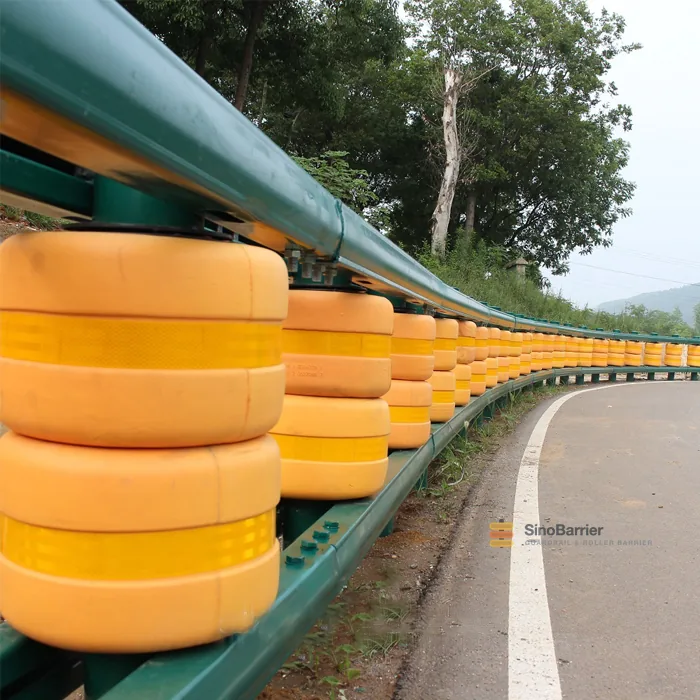
- Rotating rollers — the drums a vehicle actually contacts. Standard outer diameters are 350 mm and 400 mm, mounted in continuous rows along the run.
- Axles and frames — each roller spins on an axle fixed to the support frame; free rotation is a specified acceptance check, not an optional extra.
- Posts — galvanized steel posts at 1.0 m or 1.5 m spacing carry the frames and anchor the system to the foundation.
- Foundation and fixings — concrete foundations or driven posts, with the mounting height set so the roller rows form a continuous guided surface, typically 700–900 mm to roller centre.
The three-step impact sequence
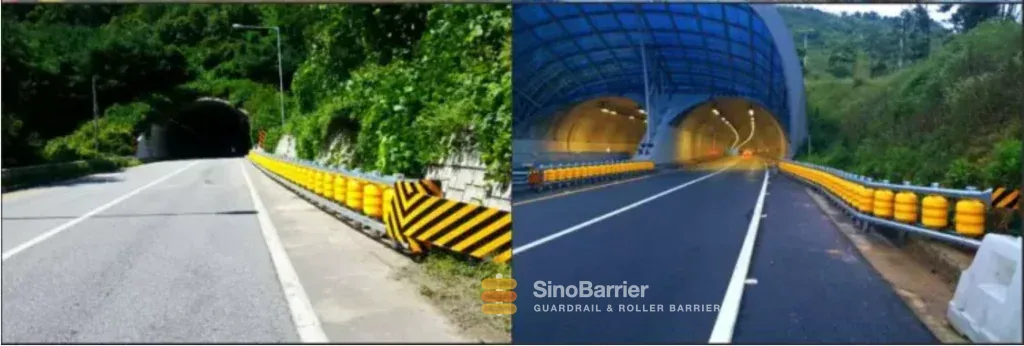
- Contact. The vehicle reaches the barrier at an angle and its body meets the rotating rollers rather than a rigid beam face.
- Energy conversion. As the vehicle pushes into the drums, they spin. A share of the vehicle’s kinetic energy becomes rotational energy in the rollers instead of deformation energy in the vehicle structure. The peak deceleration the occupants feel is reduced accordingly.
- Redirection. Because the contact surface is moving, friction does not drag the vehicle to a halt — the rolling surface guides the vehicle along the barrier line, releasing it back toward its own lane rather than reflecting it into traffic.
Why rotation matters in physics terms
A conventional W-beam stops a vehicle by deforming: the sheet steel corrugates, the posts bend, and the soil resists. All of that happens by absorbing energy through destruction, which is effective but concentrates load on the vehicle and the installation. A roller barrier shares the work:
- Longer force duration, lower peak force. Spinning drums extend the time over which the crash force is applied. For the same momentum change, a longer duration means a lower peak deceleration — the difference between a survivable steer-back and a hard rebound.
- Friction is reduced, not increased. A sliding contact against a static beam scrubs speed and pulls the vehicle nose; a rolling contact keeps the vehicle travelling and turns its velocity vector along the barrier.
- The barrier keeps its line. Because the drums rotate rather than deform, the run stays straight and serviceable, which is why near-zero deflection systems are specified next to tunnel walls and bridge parapets.
Where the mechanism pays off
- Curves and mountain roads — vehicles arrive at a shallow, high-energy angle; the rollers steer them around the bend instead of allowing a crossover.
- Tunnels — inside a confined cross-section, redirection matters more than deformation, and repair access is expensive.
- High-speed and blackspot sections — energy conversion reduces crash severity where speed differentials are largest.
- Medians on dual carriageways — near-zero deflection keeps a redirected vehicle out of the opposing lane.
What happens to the barrier after an impact?
After a crash, the run is inspected rather than rebuilt. The standard procedure: verify post plumb and foundation condition, confirm each roller still spins freely, and replace only the drums, axles or posts the impact damaged. Because the system is modular — rollers and posts are discrete units — replacement scope is usually far shorter than the replacement length a deformed W-beam run requires. The tolerance checks mirror our installation guide: spacing, mounting height and free rotation.
Is the mechanism crash tested?
Yes. The system is verified to MASH TL3/TL4 test levels and supplied to EN 1317 with CE documentation where the project requires it — the test levels and documentation are explained on our crash testing page. Test reports ship with the order documents.
Want the mechanism assessed against your alignment? Send the geometry and road class, and our engineers will tell you where a roller barrier changes the outcome and where it does not.
Discuss your alignment with an engineer
FAQ
Do the rollers need power or maintenance to keep spinning?
No. The rollers spin on sealed bearings and are driven entirely by contact — no power, no drive system. Maintenance is periodic inspection: confirm free rotation, check fixings and wash the drums where dust accumulates. A seized roller is treated as a defect because it turns a rolling contact back into a rigid point.
What happens when a car hits a roller barrier?
The rollers spin and convert part of the crash energy into rotation, steering the vehicle along the barrier line and back toward its lane. The vehicle decelerates with a lower peak force than against a rigid beam, and the barrier typically keeps its alignment with only the contacted units needing replacement.
Is a roller barrier crash tested to MASH?
Yes — the system is verified to MASH TL3/TL4 test levels, and EN 1317 documentation with CE marking is available for European projects. Test reports and certificates are issued with the shipment documents, not as an afterthought.
How is a roller barrier different from a normal guardrail?
A normal W-beam guardrail absorbs crash energy by deforming the beam and posts. A roller barrier converts energy into roller rotation and redirects the vehicle along the barrier line with near-zero deflection. The first protects by absorption, the second by redirection — which is why they suit different site conditions.
Need this specified for a live project?
Request a quotation