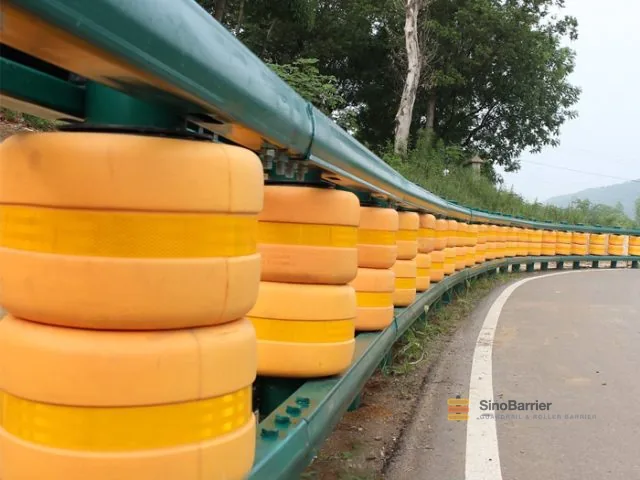
Safety Roller Crash Barrier
Safety Roller Crash Barrier
Safety roller crash barrier for road projects. Review roller sizes, posts, rails and connectors, then confirm the barrel…
View detailsRotating safety roller barriers for the locations where a fixed beam cannot absorb the energy: sharp curves, tunnel portals, median openings and gantries.
Safety roller crash barrier for road projects. Review roller sizes, posts, rails and connectors, then confirm the barrel…
View details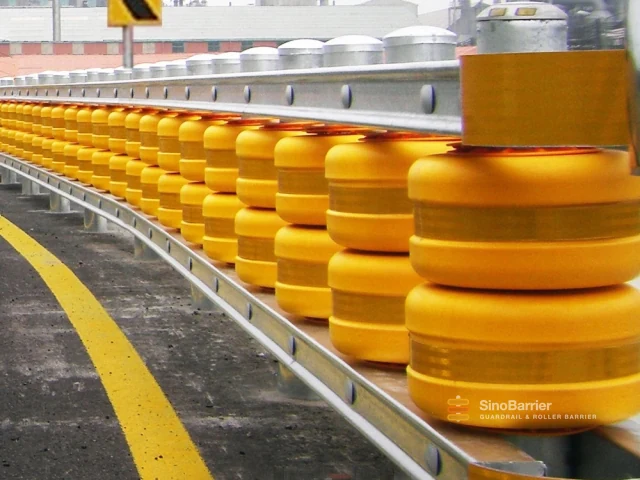
The rotary crash barrier is the coupled-roller edition of the same principle: EVA barrels on a hot-dip galvanized…
View detailsA conventional guardrail works by bending and redirecting. That is exactly what makes it a poor fit for a sharp curve, a tunnel portal or a median opening, because at a very shallow impact angle the rail can present a near-flat face that a vehicle rides up and over rather than sliding along. The roller barrier answers that with a different mechanism: the impact surface rotates.
A roller barrier is a line of cylinders mounted on a horizontal steel rail. When a vehicle strikes the run at an angle, the cylinders spin and steer the front of the car back towards the carriageway. The energy is converted through rotation rather than absorbed by permanent deformation, so the unit is reusable after impact and the run does not need replacing after a single incident. That makes it a particularly practical choice for locations where a knocked-out barrier would sit open for weeks before it could be re-tensioned.
The system is verified to MASH TL4 — the highest containment level in the MASH family, covering the largest and fastest vehicle class in the test matrix. The full test record is on the roller barrier MASH TL4 certification page.
| Roller unit | H250 × φ350 mm cylinder on a steel rail |
| System height | H250 rail, matched to the post range |
| Containment | MASH TL4 |
| Function | Rotating impact surface — steers the vehicle back to the carriageway |
| Reusability | Cylinders rotate rather than deform; units survive a hit |
| Mounting | Post and rail system, matched to the deck or shoulder condition |
| Standards | MASH TL4; rail and posts to AASHTO M180 coating |
| MOQ | 1 × 20GP container |
| Lead time | 15–25 days after deposit |
Because the deflection under impact is small, the roller barrier also suits structures where the available clearance behind the barrier is limited — a fixed beam needs room to deflect, and on a narrow bridge deck that room often does not exist.
Send the layout, the traffic direction and the containment level the project is being designed to. We will confirm the configuration, the post spacing and the fixings, then return a take-off and a factory price, usually within one working day.
Send the drawing or the tender clause. We will confirm the section, the coating weight and the post spacing, then return a take-off and a factory price — usually within one working day.
Talk to an engineerSend the drawing, the bill of quantities or just the standard you are building to. We return a take-off, a shop drawing and a factory price within one working day.