 AASHTO M180
Safety Roller Crash Barrier
Part of the Safety Roller Crash Barrier range · Roller Barrier.
Model: H250 × φ350 roller
Safety roller crash barrier for road projects. Review roller sizes, posts, rails and connectors, then confirm the barrel material, configuration and supply scope against the approved drawing.
- Standard AASHTO M180 / EN 1317 / MASH TL4
- Material EVA/Polyurethane for barrel,and Q235/Q345 for guardrail
- Surface Hot-dip galvanized, ≥ 550 g/m²
- MOQ 1 × 20GP container
- Lead time 15–25 days
- Mill test certificate with every shipment
- Shop drawings and setting-out plan included
- Custom lengths, hole patterns and coating weights
Technical specification
| Roller (royalty barrel) | H250xφ350mm,H500xφ350,request |
| Post | φ140x2150x4.5mm |
| Cross beam | 100x80x4.0x6000mm |
| Connecting rack | 430x84x70x4.0mm |
| U shape frame | 380x70x6.0mm |
| Turning circle | φ182xφ145×2.0mm |
| Square buckle | 46x64x4.0mm |
| Terminal | 1300x230x2.0mm |
| Bolts&Nuts | M20x60/120/140mm |
| Post spacing | 700 mm or 1000 mm as request drawing |
| Material | EVA/Polyurethane for barrel,and Q235/Q345 for guardrail |
| Operating temperature | -60℃~70℃(-76℉~158℉) |
| Anti-corrosion coefficient | 3 times more than the ordinary guardrail |
| Crash test | MASH TL4 — full test matrix (Test 4-10 / 4-11 / 4-12) |
| Port of Loading | Qingdao,Tianjin |
| Payment | 30% deposit, 70% balance by T/T,L/C,Trade Assurance |
| Capacity | 5000 tons for guardrail,10000 pcs barrels |
| Packing | Opp bag+woven bag+carton+container |
| Delivery | 5-7 working days |
| Price term | EXW,FOB,CIF |
Dimensions shown are the standard range. Non-standard lengths, hole patterns and coating weights are produced to order — send your drawing for a confirmation drawing.
Description
Safety roller crash barrier: where it is used
This product page lists the safety roller crash barrier components for road-project procurement. Check the selected roller size, post layout, rails, terminals and connectors against the approved drawing. For complete-system selection and a project quotation, use our highway roller barrier supply page.
How the roller absorbs and redirects
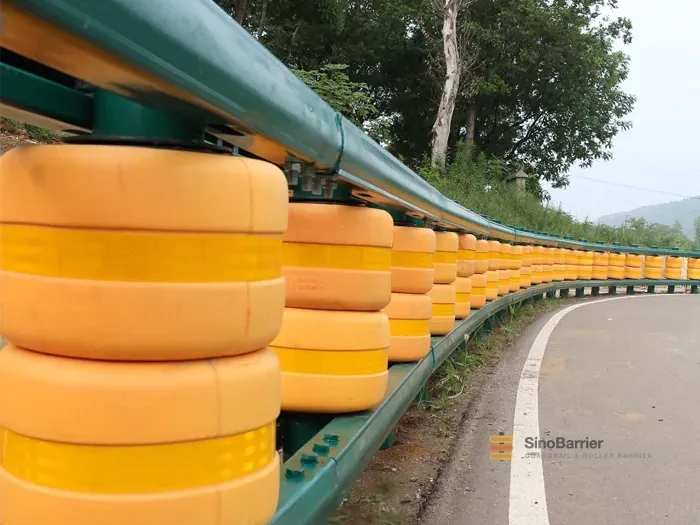
Each roller turns on its axle as the vehicle touches it, so part of the impact energy goes into rotation rather than into the vehicle or the post. The rollers are set at a spacing that keeps the line continuous to a wheel, and the steel U-beam behind them carries the load the rollers pass on. The result is a barrier that slows a vehicle over a longer distance than a rigid wall and keeps it parallel to the road.
What the roller is made of
The current component specification lists EVA or polyurethane for the roller barrel and Q235/Q345 steel for the frame and posts. Confirm the selected barrel material, component sizes and coating requirement in the approved drawing and quotation; a material name alone does not establish the performance of the installed system.
MASH TL4 crash testing
Review the roller barrier test-document information and request the report for the proposed system. Match the tested configuration, post spacing, anchorage and component schedule to the project requirement before ordering. A test level belongs to the tested assembly and does not automatically cover a changed configuration.
Products specification
Roller material and colour are confirmed in the order specification. Provide the approved component drawing and any colour or visibility requirements with the enquiry.
When the rolling guardrail is hit by the vehicle, the roller can rotate under the impact force, driving trajectory of runaway vehicle from the vertical direction parallel to transform guardrail direction, in order to resolve the impact force and reduce the severity of collision accident.
After an impact, inspect the complete assembly and follow the applicable maintenance instructions before returning the barrier to service. Replace damaged components as required.
Features of the safety roller barrier
The roller turns instead of resisting, the reflective band keeps the line visible at night after night, and the moulded compound is recyclable at the end of its service. Because the rollers are separate parts on a steel frame, a damaged roller can be replaced on its own without taking out the run, which keeps maintenance cost down on a barrier that is meant to be struck.
Where the roller barrier is installed
- Curved medians and curved ramps, where the alignment itself is the hazard.
- Diverging points and passage intersections, where a fixed barrier would present an edge.
- Curved tunnel sections and curved downhill runs, where a vehicle leaves the lane at speed.
- School zones and other hazard zones where the consequence of a run-off is severe.
Frequently asked questions
- How is the safety roller barrier crash tested?
- Request the report for the selected assembly and compare its configuration with the project drawing. Confirm the applicable test level and report scope rather than assuming that a component or a modified layout inherits the result.
- What are the rollers made of and how do they behave?
- EVA and polyurethane for the barrel, with Q235 and Q345 steel for the frame and posts. The rollers spin on impact so the vehicle is turned back into its lane instead of being stopped dead, which is why the system is used where the alignment itself is the hazard.
- What are the standard component sizes and post spacing?
- Rollers at H250 × φ350 mm or H500 × φ350 mm on φ140 × 2150 × 4.5 mm posts, with a 100 × 80 × 4.0 × 6000 mm cross beam and post spacing of 700 mm or 1000 mm to the drawing. The operating temperature range is −60 °C to 70 °C.
- What happens after an impact?
- Inspect the rollers, rails, posts, connections and anchorage after an impact. Replacement requirements depend on the damage and the maintenance instructions for the installed system.
Key features
- Rotating EVA / PU rollers redirect the vehicle instead of stopping it
- Crash-tested configurations to MASH TL4
- Hot-dip galvanized steel frame, posts and cross beams
- Rebuildable after impact — replace only the damaged roller
- Supplied as a complete kit: rollers, frame, posts and anchors
Where it is used
- Sharp curves and high-risk bends
- Tunnel portals
- Median openings and crossovers
- Bridge approaches
- Toll plazas and gantries
- Airport aprons and service roads
Not sure which specification fits?
Tell us the road class, design speed and the standard your client is working to. Our engineer will come back with the section, the coating weight and the post spacing that meet it — and the price for the quantity you need.
Ask an engineerOther items in this range
Rotary Crash Barrier
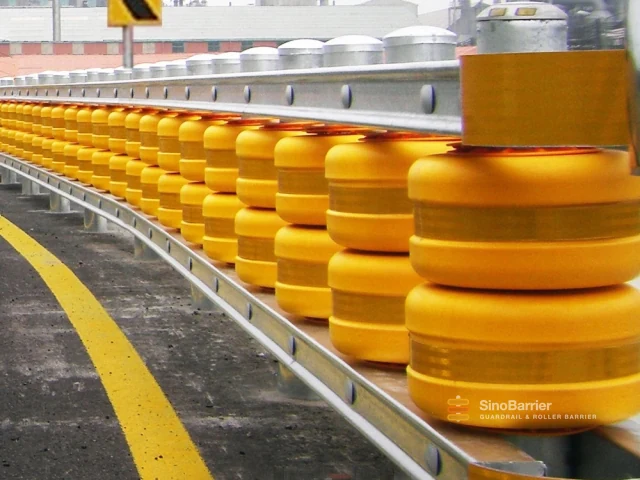
The rotary crash barrier is the coupled-roller edition of the same principle: EVA barrels on a hot-dip galvanized…
View detailsMore on Safety Roller Crash Barrier
Roller Barrier Dimensions and Weight
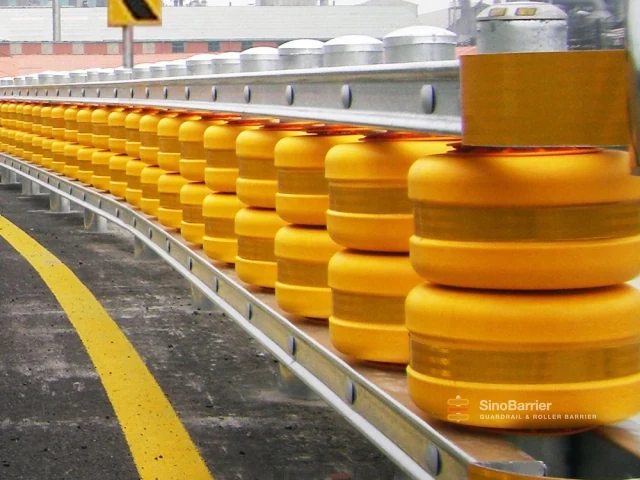
Short answer: a roller barrier unit uses 350 mm or 400 mm diameter rollers at 1.0 m or 1.5 m post spacing,…
Read more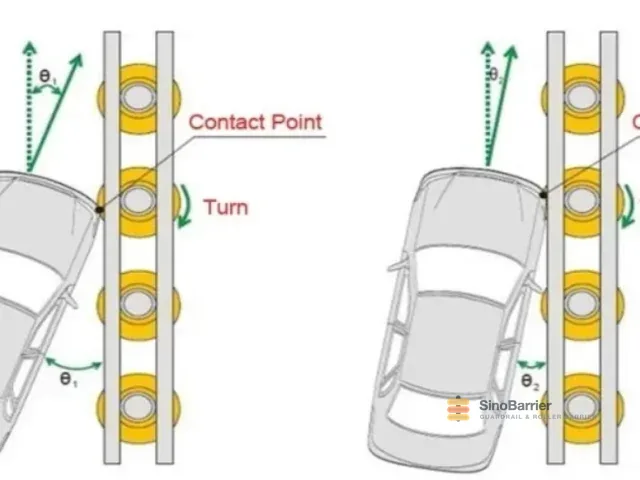
Roller Barrier Installation Guide
Short answer: a roller barrier is installed in six stages — set out the line, prepare the foundations, set the posts, mount…
Read more